Terms:
Prompt: "visualize unlearning", made with Ideogram, January 2025
Maj Ørskov: "Since, in the context of the artistic practices that interest me, the practice of unlearning relates directly to the production, circulation and instrumentalization of knowledge, I also find the concept of unlearning to be a key methodological stance to think, write and practice through when interacting analytically with these works." Continue reading
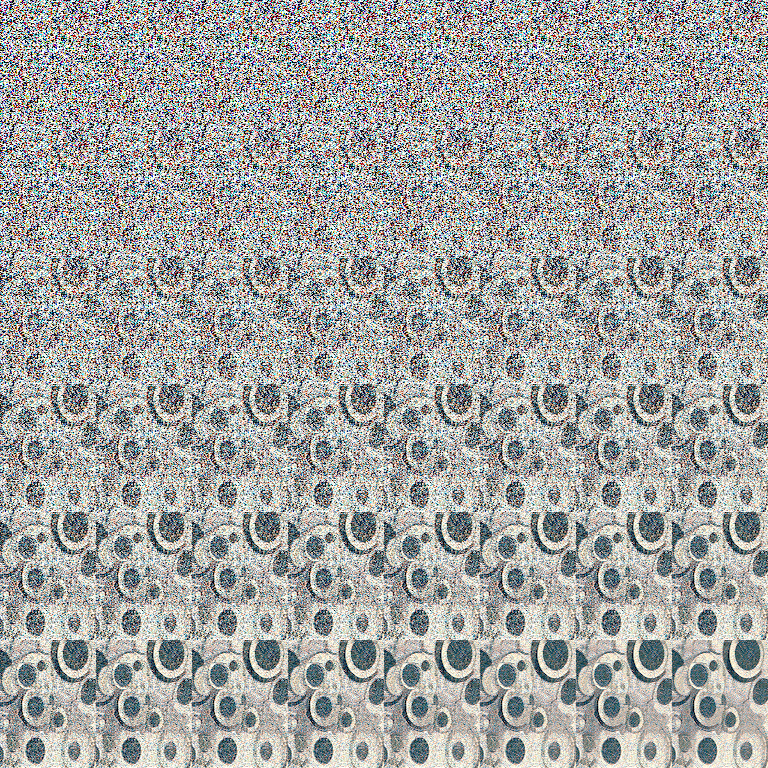
All the steps towards an image generated with Stable Diffusion XL and the prompt "Thinking, writing, practicing in circles", January 2025.
Maj Ørskov: "we, researchers of contemporary art, are forced not just to work progressively in line with the history of art, when composing a problem or object of analysis, but to work in circles across the analytic material that we find of relevance." Continue reading
An image generated with the prompt "The aesthetic is political". The red dots show the zones of the image activated by the word "political" in the prompt. The visualization is created using DAAM, March 2025.
Jacob Lund: "The aesthetic is political precisely because of its ability to differentiate itself from the normally inconspicuous organization of our everyday lifeworld, and, through such differentiation, provoke critical reflection on this organization — which is what makes a certain degree of exhibition of decisive importance.[2]" Continue reading
Maj Ørskov: "I want to ask what consequences this implied precedence of reflexivity over more bodily circumstances has for the analytic potential of the term. In Rebentisch’s and Lund’s writing on the phenomenon, I find a lack of reflections regarding the more “practical” or "material" (in lack of better words) dimensions of reflexive transformation. Under which spatial-temporal conditions can an intense exchange between an interpreting subject and a sensemaking object come to qualify as reflexive transformation?" Continue reading
Prompt: visualize reality, made with Ideogram, January 2025
Jacob Lund: "Reality is constituted by what is at work, virker, in the world; by what is in operation, what operates; and by what has effects and informs our perception and understanding of the world. The artistic practices in question here operate in and on reality and demonstrate that the reality of the world, virkeligheden, is negotiable and can be made to work, virke, otherwise." Continue reading
Prompt: visualize planetary entanglement, made with Ideogram, January 2025
Jacob Lund: "Entering the anthropocene epoch influences our very perception of time. Hence, we are not only dealing with a new epoch replacing an old one, the Holocene, in a process of linear progressive development – which in the case of the Earth spans more than 4,5 billion years, a time scale that is highly abstract to our human perception. The new epoch is also accompanied by an increasing need for us to relate to a planetary scale, according to which we, as inhabitants of the same Earth, globally and across our cultural differences and national histories, share the same historical now, the same present." Continue reading
A composite of four images generated with the prompt "to understand the different processes and gestures which together constitute ordinary analysis within art research today" by Stable Diffusion. On the left top, the red and yellow zones represent the parts of the image most affected by the term "art". On the top right, the zones affected by the term "and". On the bottom row, the red and yellow zones represent the parts affected by the terms "ordinary" and "research" respectively. March 2025.
Maj Ørskov: "Consequently, I would say that the core practice of humanistic research in general, and particularly the core practice of art research, is analysis. However, I find that we have a relatively poor language to understand the different processes and gestures which together constitute ordinary analysis within art research today." Continue reading
Prompt: visualize institutions/ dependencies/ entanglement, made with Ideogram, January 2025
Nicolas Malevé: "Art is not only art and its methods proliferate outside of its traditional remits under the constraint of an external factor. The art school inundates the art world and a majority of trained artists are excluded from the art market (or who refuse to join it or abide by its rules, a combination of all that). This population is not just an army of reserve for the art world or art education. They learn other professions, they are “reconverted”. Continue reading
A composite of two images generated with the prompt "a global interconnection of different presents" by Stable Diffusion. On the left, the red zones represent the parts of the image most affected by the term "interconnection". On the right, the zones affected by the term "present". March 2025.
Jacob Lund: "What I find crucial about our present, the present present, is that it is conditioned by con-temporaneity, understood as a global interconnection of differentpresents, with different pre-histories, and of different time-experiences. It is an idea of contemporaneity as a, at least in principle, shared present across divisive cultural and historical differences; of a temporary unity of the present across the planet." Continue reading
Prompt: Amateurish photo of the new york modern museum of art in flames contrast between the white building and the flames at night with a crowd of disguised artists demonstrating, generated with Flux Schnell, March 2025.
Nicolas Malevé: "Indeed the consequences of the perilous exercise of pleasing collectors and donors whilst decolonizing the collection offers the perfect fetish to the alt right that never tires to denounce the hypocrisy of the left and their secret alliance to the elite. Whilst museums are in a perfect trap, the institutions that sought to give structural room of manoeuvre to progressive projects, such as the recent documenta, are not in a better place." Continue reading
Image: On the left, an image generated with Stable Diffusion 1.4 and the prompt "a certain openness in regard to sense". On the right, a visualization of the parts of the image (in yellow and red pixels) which correspond to the zones activated by the word "regard" in the prompt. March 2025.
Jacob Lund: "The act of showing, displaying, exhibiting and demonstrating something, is an indispensable part of the manifestation of any work of art – contemporary as well as modern – and hence a condition for its being perceived and experienced. This is not yet, however, what makes the thing being shown art or an aesthetic object, be it physical or not. What makes it artistic, or at least aesthetic, is a certain openness with regard to the sense or signification of the thing that appears, which ignites a process of reflexivity that, ultimately, is a negotiation of the world and how we live in it." Continue reading
Prompt: visualize diagramming, made with Ideogram, January 2025
Nicolas Malevé: "The practice of diagramming requires the unlearning of expected positions, working against my initial assumptions. To undo a certain image of the controversy that I have in mind when I encounter a situation." Continue reading
Prompt: visualize critical assemblage, made with Ideogram, January 2025
Nicolas Malevé: "Critical assemblage presumes that to critique is not simply to formulate an argument against something or someone. It is to assemble the conditions for a critique to be formulated and be listened to as much as to formulate an argument. These conditions are not determined by the subject who formulates the critique alone. This means that the locus of the critique is distributed." Continue reading
All the steps towards an image generated with Stable Diffusion XL and the prompt "an aesthetics that includes more-than-human agents", March 2025.
Jacob Lund: "We are in need of developing an aesthetics that includes more-than-human agents and recognises that we are bound to Earth and inescapably entangled in its dynamic being, but without letting go of human responsibility and political agency." Continue reading
Prompt: visualize composition, made with Ideogram, January 2025
Maj Ørskov: "I am aware that the practice of composition as laid out here contributes to further expose the fundamental fragility and unprovability of our knowledge production systems, but I say: wonderful!" Continue reading
Nicolas Malevé: "To compose an object then requires to move across all the layers of this problem. To strategically contribute to the general economy of attention, to work on the conditions of discernibility. And be reflexive about the implications of making visible and discernible." Continue reading
Prompt: visualize artistic autonomy, made with Ideogram, January 2025
Jacob Lund: "My assumption is that we, if we are to talk about artistic autonomy today, should talk about the autonomy of a particular form of practice and the experiential process that is related to this practice, rather than the autonomy of a given object-based work or the subject position of the artist as autonomous." Continue reading
Prompt: visualize what aesthetic practice is, made with Ideogram, January 2025
Jacob Lund: "Thus, artistic aesthetic practice is not only a particular way of engaging with the sensuous world, but also involves the production of aesthetic reflective perception. In artistic practice the production of aesthetic perception is addressed to a public. In this sense, an artistic aesthetic practice proper involves the invitation of an audience, a public, to take part in the process of sensing and sense-making." Continue reading
Prompt: "visualize unlearning", made with Ideogram, January 2025
Maj Ørskov: "Since, in the context of the artistic practices that interest me, the practice of unlearning relates directly to the production, circulation and instrumentalization of knowledge, I also find the concept of unlearning to be a key methodological stance to think, write and practice through when interacting analytically with these works." Continue reading
All the steps towards an image generated with Stable Diffusion XL and the prompt "Thinking, writing, practicing in circles", January 2025.
Maj Ørskov: "we, researchers of contemporary art, are forced not just to work progressively in line with the history of art, when composing a problem or object of analysis, but to work in circles across the analytic material that we find of relevance." Continue reading
An image generated with the prompt "The aesthetic is political". The red dots show the zones of the image activated by the word "political" in the prompt. The visualization is created using DAAM, March 2025.
Jacob Lund: "The aesthetic is political precisely because of its ability to differentiate itself from the normally inconspicuous organization of our everyday lifeworld, and, through such differentiation, provoke critical reflection on this organization — which is what makes a certain degree of exhibition of decisive importance.[2]" Continue reading
Maj Ørskov: "I want to ask what consequences this implied precedence of reflexivity over more bodily circumstances has for the analytic potential of the term. In Rebentisch’s and Lund’s writing on the phenomenon, I find a lack of reflections regarding the more “practical” or "material" (in lack of better words) dimensions of reflexive transformation. Under which spatial-temporal conditions can an intense exchange between an interpreting subject and a sensemaking object come to qualify as reflexive transformation?" Continue reading
Prompt: visualize reality, made with Ideogram, January 2025
Jacob Lund: "Reality is constituted by what is at work, virker, in the world; by what is in operation, what operates; and by what has effects and informs our perception and understanding of the world. The artistic practices in question here operate in and on reality and demonstrate that the reality of the world, virkeligheden, is negotiable and can be made to work, virke, otherwise." Continue reading
Prompt: visualize planetary entanglement, made with Ideogram, January 2025
Jacob Lund: "Entering the anthropocene epoch influences our very perception of time. Hence, we are not only dealing with a new epoch replacing an old one, the Holocene, in a process of linear progressive development – which in the case of the Earth spans more than 4,5 billion years, a time scale that is highly abstract to our human perception. The new epoch is also accompanied by an increasing need for us to relate to a planetary scale, according to which we, as inhabitants of the same Earth, globally and across our cultural differences and national histories, share the same historical now, the same present." Continue reading
A composite of four images generated with the prompt "to understand the different processes and gestures which together constitute ordinary analysis within art research today" by Stable Diffusion. On the left top, the red and yellow zones represent the parts of the image most affected by the term "art". On the top right, the zones affected by the term "and". On the bottom row, the red and yellow zones represent the parts affected by the terms "ordinary" and "research" respectively. March 2025.
Maj Ørskov: "Consequently, I would say that the core practice of humanistic research in general, and particularly the core practice of art research, is analysis. However, I find that we have a relatively poor language to understand the different processes and gestures which together constitute ordinary analysis within art research today." Continue reading
Prompt: visualize institutions/ dependencies/ entanglement, made with Ideogram, January 2025
Nicolas Malevé: "Art is not only art and its methods proliferate outside of its traditional remits under the constraint of an external factor. The art school inundates the art world and a majority of trained artists are excluded from the art market (or who refuse to join it or abide by its rules, a combination of all that). This population is not just an army of reserve for the art world or art education. They learn other professions, they are “reconverted”. Continue reading
A composite of two images generated with the prompt "a global interconnection of different presents" by Stable Diffusion. On the left, the red zones represent the parts of the image most affected by the term "interconnection". On the right, the zones affected by the term "present". March 2025.
Jacob Lund: "What I find crucial about our present, the present present, is that it is conditioned by con-temporaneity, understood as a global interconnection of differentpresents, with different pre-histories, and of different time-experiences. It is an idea of contemporaneity as a, at least in principle, shared present across divisive cultural and historical differences; of a temporary unity of the present across the planet." Continue reading
Prompt: Amateurish photo of the new york modern museum of art in flames contrast between the white building and the flames at night with a crowd of disguised artists demonstrating, generated with Flux Schnell, March 2025.
Nicolas Malevé: "Indeed the consequences of the perilous exercise of pleasing collectors and donors whilst decolonizing the collection offers the perfect fetish to the alt right that never tires to denounce the hypocrisy of the left and their secret alliance to the elite. Whilst museums are in a perfect trap, the institutions that sought to give structural room of manoeuvre to progressive projects, such as the recent documenta, are not in a better place." Continue reading
Image: On the left, an image generated with Stable Diffusion 1.4 and the prompt "a certain openness in regard to sense". On the right, a visualization of the parts of the image (in yellow and red pixels) which correspond to the zones activated by the word "regard" in the prompt. March 2025.
Jacob Lund: "The act of showing, displaying, exhibiting and demonstrating something, is an indispensable part of the manifestation of any work of art – contemporary as well as modern – and hence a condition for its being perceived and experienced. This is not yet, however, what makes the thing being shown art or an aesthetic object, be it physical or not. What makes it artistic, or at least aesthetic, is a certain openness with regard to the sense or signification of the thing that appears, which ignites a process of reflexivity that, ultimately, is a negotiation of the world and how we live in it." Continue reading
Prompt: visualize diagramming, made with Ideogram, January 2025
Nicolas Malevé: "The practice of diagramming requires the unlearning of expected positions, working against my initial assumptions. To undo a certain image of the controversy that I have in mind when I encounter a situation." Continue reading
Prompt: visualize critical assemblage, made with Ideogram, January 2025
Nicolas Malevé: "Critical assemblage presumes that to critique is not simply to formulate an argument against something or someone. It is to assemble the conditions for a critique to be formulated and be listened to as much as to formulate an argument. These conditions are not determined by the subject who formulates the critique alone. This means that the locus of the critique is distributed." Continue reading
All the steps towards an image generated with Stable Diffusion XL and the prompt "an aesthetics that includes more-than-human agents", March 2025.
Jacob Lund: "We are in need of developing an aesthetics that includes more-than-human agents and recognises that we are bound to Earth and inescapably entangled in its dynamic being, but without letting go of human responsibility and political agency." Continue reading
Prompt: visualize composition, made with Ideogram, January 2025
Maj Ørskov: "I am aware that the practice of composition as laid out here contributes to further expose the fundamental fragility and unprovability of our knowledge production systems, but I say: wonderful!" Continue reading
Nicolas Malevé: "To compose an object then requires to move across all the layers of this problem. To strategically contribute to the general economy of attention, to work on the conditions of discernibility. And be reflexive about the implications of making visible and discernible." Continue reading
Prompt: visualize artistic autonomy, made with Ideogram, January 2025
Jacob Lund: "My assumption is that we, if we are to talk about artistic autonomy today, should talk about the autonomy of a particular form of practice and the experiential process that is related to this practice, rather than the autonomy of a given object-based work or the subject position of the artist as autonomous." Continue reading
Prompt: visualize what aesthetic practice is, made with Ideogram, January 2025
Jacob Lund: "Thus, artistic aesthetic practice is not only a particular way of engaging with the sensuous world, but also involves the production of aesthetic reflective perception. In artistic practice the production of aesthetic perception is addressed to a public. In this sense, an artistic aesthetic practice proper involves the invitation of an audience, a public, to take part in the process of sensing and sense-making." Continue reading
All the steps towards an image generated with Stable Diffusion XL and the prompt "Thinking, writing, practicing in circles", January 2025.
Maj Ørskov: "we, researchers of contemporary art, are forced not just to work progressively in line with the history of art, when composing a problem or object of analysis, but to work in circles across the analytic material that we find of relevance." Continue reading